
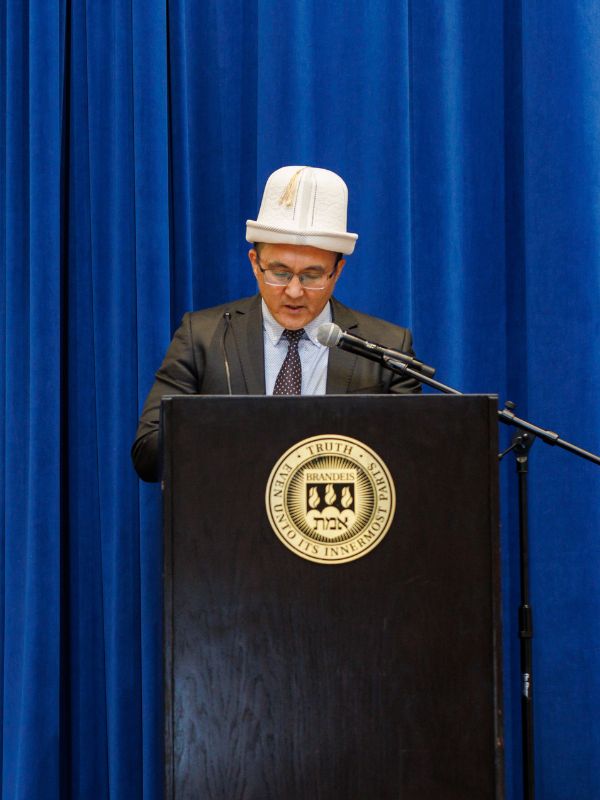
 Good afternoon, dear faculty, classmates, friends, and families.
It is a true honor to speak today on behalf of the graduates of the Global Sustainability Policy and Management program. We are the very first graduating class of this program, and today we are not just completing our studies—we are becoming part of a new chapter in Heller’s history.
When I came to Brandeis, I was already decades into my professional career. So, at the beginning of the program, one of my classmates asked me, “Why did you come to study when you are already at the age when you should be teaching others?” Although the question was meant as a lighthearted joke, as an older graduate student, I did not quite know how to answer it at the time. But then I met a 72-year-old student, the same age as my mother, and, honestly, I felt inspired by her and was totally reassured that education can add value to every chapter of our lives. She is studying neuroscience, planning to apply for a PhD, and she asked me to tell my mother that she should go back to school too. I absolutely will.
My journey to Brandeis began far from Waltham, in a small village called Chaek in Kyrgyzstan. Over the years, that journey took me through different stages of serving justice and people, and eventually brought me here to Heller as a Fulbright Scholar. I served as a judge, worked on reforms, and through thousands of legal cases, I came to see the human stories behind them. And it was then that I understood something important: behind many cases, there is not just a legal issue, but a person who is trying, perhaps for the very first time, to be heard.
But Heller helped me see this idea in a broader way—through public policy, sustainable development, and the role of institutions. Formal rights must become real access, and individual reforms must become lasting institutions that serve people. Because a law can look right on paper, and yet a person can still be left facing the system alone. Real justice becomes possible when a woman, a child, a low-income family, or someone without protection can truly be heard, receive help, and keep their dignity.
That is why, for me, Heller became not just a place of study, but a space where my professional experience took on new meaning. And now, at the end of my time at Heller, I can answer my classmate’s question: age and experience do not remove the need to learn. On the contrary, the more we have seen in life, the more important it becomes to gain a new perspective, so that we can serve people better.
In these difficult times, I want to express my deep gratitude to Heller and to our faculty. You have remained committed to humanity, justice, and hope.
I am especially grateful to my academic advisor, Professor Joel Cutcher-Gershenfeld; to our director, Sandra Jones, and her deputy, Mary Poor; to Professors Rajesh Sampath, Lisa Lynch, and Joseph Assan; to Lecturer Eric Greene; and to ELP consultants Scott Moore and Angela Tribus for their support.
Thank you to my classmates. Each of you brought your country, your story, and your hope into this community. Thank you to my family, who, despite the distance, stood by me throughout this entire journey. And thank you to my compatriot, Nazira, who is also graduating from the SID program this year, and to her husband, Nurlan. They welcomed me so warmly that America began to feel closer to home.
Martin Luther King Junior once said, “I have a dream.” I have a dream too: that we and our children will live in a world where justice does not depend on the country where we were born, our income, our gender, or our status; where the system serves humanity; and where people know how to listen to one another, even in difficult times.
For me, Heller has been a bridge to a new understanding that sustainable development is not only about economics, ecology, or policy. It is about a future where development leaves no one behind, and where institutions serve human dignity.
And if I take just one thought with me from here, it is this: service to society begins where the person matters more than the system, and justice matters more than convenience.
Congratulations, Class of 2026!
Děkuji, Gracias, Shukriya, Tunhji meharbani, Kadrinchay, Menatwaar, Webale, Rakhmat, and thank you.