
This resource represents a collaborative effort using questions from current and prospective nursing parents. It is authored by Alesha Thomas, BS, IBCLC, a disabled certified lactation consultant, mom, and founder of the Adaptive Parent Project; researchers and colleagues at the National Center for Disability and Pregnancy Research (NCDPR); and NCDPR Advisory Board members.
Sections
Click on a topic to jump to that section:
- Grounding Statement and Friendly Reminder
- Breastfeeding with a Disability
- Advocating for Resources
- Supplies for Lactation
- Resources
- Sources

Grounding Statement & Friendly Reminder
While this resource offers information about lactation, producing enough breast milk may not be possible for some parents.
This can be a difficult and emotional experience. For disabled parents, the pressure to ‘prove’ yourself can make struggling to lactate even more stressful.
Feeding your baby, in whatever way is possible, whether through lactation or formula, is the goal. Whatever keeps baby and parent nourished and well is what matters.
Breastfeeding with a Disability
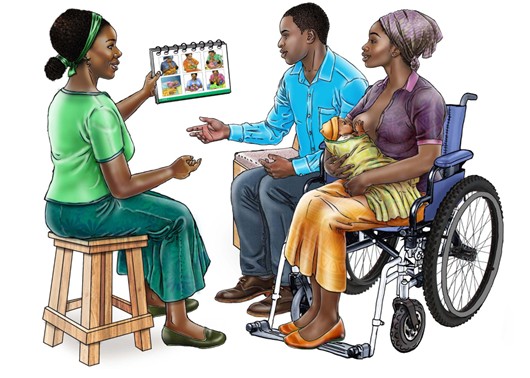
Image credit: USAID Advancing Nutrition
How do you minimize sleep deprivation and burn out while breastfeeding as a disabled mother?
Tell your partner, family, and friends that you hope to breastfeed and you’ll need their support to make it happen. They can help you position the baby, position yourself, change the baby after you nurse, and do other tasks to help you get as much sleep as possible. Have stations set up wherever you plan to feed, for example a rolling cart or basket with pump parts, snacks, water, breastfeeding pillow and anything you use to help position the baby and to keep yourself comfortable. Breastfeeding can be exhausting and both physically and emotionally challenging. Incorporate self-care strategies — rest, therapy, peer support, and pacing — into your plan.
Who can help me learn how to breastfeed?
During your prenatal visits, you can discuss your plan for breastfeeding with your provider, and ask them to make sure that a lactation consultant will visit you in the hospital after you give birth. Breastfeeding will likely also be part of your prenatal classes — for a disability perspective see our webinar on Breastfeeding with a Disability. Connecting with another disabled mother who breastfed can also be very helpful. If you cannot find a peer in your geographical area, you might be able to connect with another mom virtually (see disability-supportive pregnancy and lactation community later in this section). You can contact Kara Ayers directly to be connected with a disabled peer to discuss an Accessible Pregnancy Action Plan — which would include your plan for pregnancy, birth, and lactation.
It’s normal for there to be new challenges as your baby gets bigger. You can ask your doctor, lactation consultant, peer mentor, or other support people to help you to identify potential solutions to those challenges.
What positions will work for me?
It’s all about experimentation and finding what works best for you and your baby. Some positions might work for one side and not another. Many parents say that breastfeeding while lying down is very helpful for them. See the graphic for illustrations and examples.
How do you breastfeed with one hand and hold a baby?
There are many ways to approach this. Position techniques will change as the baby gains head and trunk control.
- Use positions such as lying on your back, side lying and/or koala hold/upright hold.
- Use breastfeeding pillows and other supports as needed.
- The Joeyband skin-to-skin band can also be used for support while seated or lying down.
- Some baby wearing carriers can be a good support option as well (for this, reach out to a certified baby wearing educator to find the best option that works for you).
What advice do you have for disabled parents feeding twins or multiples?
Feeding twins or multiples can present unique challenges. Finding out what feeding positions work best for the parent and the babies may require more time and support. Positions that may be helpful for multiples include laid back, side lying, koala hold, or front “v” hold. For bottle feeding bottle handles can offer extra grip support.
How can I find a disability-supportive pregnancy and lactation community?
Join support groups for disabled parents such as Wheel Good Motherhood on Instagram, Quad Squad on Facebook, and/or Deaf/Signing Breastfeeding Mothers on Facebook. There are groups that are disability wide, or you can search for your specific type of disability. Some groups are geographical, so you could add the closest major city or your state name when you search. Find more suggestions in the Resources section of this webpage.
View the graphic in the resources section for illustrations and examples
 Advocating for Resources
What if my doctor’s office or hospital is not providing ASL?
Remind your doctor that federal laws require equal access to care, information, and communication in all health care settings; they need to provide ASL interpreters for you.
What if the resources given to me are inaccessible?
If you cannot access or if you do not understand the resources that your doctor, nurses, and lactation consultants are providing, you can ask them to make the resources accessible to you. It might be helpful to ask another person to accompany you to an appointment and practice having the conversation with them.
How can I talk to my doctor and lactation consultant about my specific needs?
The Accessible Pregnancy Action Plan may be a helpful resource to guide the conversation and help you create a birth plan that accounts for your specific needs.
You could send them our Breastfeeding with a Disability: Resource for Providers document (coming soon). NCDPR is working on this companion document for providers — please check back soon for the link.
Could I use a doula?
Doulas are trained, non-clinical professionals who provide emotional, physical, and information support to a pregnant person. Many states include a perinatal doula benefit for recipients of Medicaid. Ask your provider. A doula, especially a doula that is knowledgeable about disability, may be helpful in prenatal care, birth, and care after the baby is born, like help with breastfeeding.
What if I need more help?
Many disabled moms have described the importance of receiving physical assistance with breastfeeding from others, especially spouses and family members. They also received help with setting up a breast pump and positioning their baby.
Depending on your needs, you may benefit from in-home occupational and/or physical therapy. Ask a provider for a referral for these services. Many local municipalities have maternal and child health (MCH) programs that provide visiting home nurses who can offer support. Program offerings, and their eligibility requirements, vary by location. You can reach out to your child’s pediatrician or your local public health department to learn more.
Early Intervention services (EI) can be a tremendous source of support for new parents. Early Intervention services, like nurse home visitors, have eligibility requirements that vary by state.
How do I bring this information to my area? It's so important that we ALL get the support we need!
Depending on the size of your area, we suggest reaching out to other local professionals such as occupational therapists, doulas and other maternal health professionals as well as disabled parents living in your area. Peer support can be incredibly helpful for new disabled parents. If you need help connecting with other disabled parents, please contact AdaptiveParentProject@gmail.com.
You can also contact Nicole Lomerson, who works for both the National Center for Disability and Pregnancy Research and The National Research Center for Parents with Disabilities, for information and technical assistance. Please contact Nicole at NicoleLomerson@Brandeis.edu or at CenterForParents@brandeis.edu.
 Supplies for Lactation and Parenting
What are some go-to accessible lactation and baby items for parents with disabilities?
Please note: The products and opinions listed in this section are not endorsed by or affiliated with The Lurie Institute, The National Center for Disability and Pregnancy Research, or our funders. Very little research and evidence-based practice exists on the subject of adaptive baby care and lactation equipment for parents with disabilities. These suggestions are made based on the personal experiences of Alesha Thomas, BS, IBCLC; her clients; and Lurie staff members who have lived experience either parenting or caring for babies and small children. This document is for information purposes only and should not be used as medical advice. Please contact your medical provider if you have specific questions related to lactation and breastfeeding.
● Breastfeeding pillows with a strap that wraps around the parent’s body (such as the ‘Breast Friend’ pillow or the ‘Boppy Best Latch’ nursing pillow) can assist with positioning and prevent the baby from kicking the pillow on the floor when feeding.
● Wearable breast pumps can often be more disability friendly for milk expression when needed.
Note: Evaluation by a qualified professional (such as an OT or a certified lactation consultant) may be helpful in determining the type of breast pump that is most appropriate.Below are some disability-friendly and helpful products commonly recommended by disabled parents.
- The Joeyband — Great for skin-to-skin contact and added support while holding the baby seated or lying down.
- Hippie Joey Carrier — Size of carrier is based on measurements; the carrier is one piece of fabric–no buckles or straps to adjust.
- LapBaby — The LapBaby is a cushioned belt that wraps around parent and baby while seated. It was designed as a method to keep a baby secure on a parent’s lap. Many parents who use wheelchairs report that this product works well to secure their child to their lap. This device is meant to be used only while seated, and only with babies who can hold their head without support.
- Arms Reach Co-Sleeper — This bassinet attaches securely to the parent's bed to allow for easier night access to the baby for breastfeeding, diaper changes, etc.
- Halo Bassinet — Halo baby bassinets are designed to provide a safe alternative to co-sleeping.The legs of the bassinet makes it easier for wheelchair users to get closer to the bassinet, as well as pull it closer to you in bed.
- Gertie Crib — An accessible crib that comes with 3 sets of crib legs for adjustable height, and has a set of fold out doors on the side that allow for easy access to the baby.
- Guava Family Lotus Travel Crib — This crib unzips from the side. Some disabled parents may find this to be an easier way to get the baby in and out of the crib. The crib mattress sits on the floor which means the side walls are at a lower height that may be easier for parents in wheelchairs and parents of short stature to access the baby.
- Stokke Tripp Trapp High Chair
- This chair converts to a regular chair that supports up to 300 lbs.
- Very easy to bring under with a wheelchair. *Not on wheels.
- There are other Stokke highchairs that attach directly to dining table chairs.
- Magnetic Me Clothing — Magnetic closure clothing for baby, toddler, kids. Adult sized clothing items are limited to pajamas.
- Boppy Uplift Nursing Pillow — This product has a strap so it stays secure while feeding.
Again, individual needs will vary. The Adaptive Parenting Project YouTube channel has videos on some of these products. Reach out to Alesha if you have questions.
 Resources
Deaf & Hard of Hearing Breastfeeding Collective
- A Facebook page for DHH Breastfeeding. Inaugural Deaf & Hard of Hearing Breastfeeding Week was September 16-22, 2025.
Facebook peer support group for Deaf/Signing Breastfeeding Mothers
Facebook peer support group for Deaf Babywearing Community
Adaptive Parent Project
Adaptive Parent Project (APP) is a 501(c)(3) nonprofit dedicated to empowering parents with all types of disabilities. Our mission is to provide an inclusive resource to help people with disabilities and their children thrive. We are here for anyone who is parenting with a disability.
Wheel Good Motherhood: Free Monthly Peer Support Groups
Wheel Good Motherhood is a free monthly peer support group for current and prospective wheelchair-using moms to join together and discuss the ups and downs of mothering on wheels. This group offers a safe and supportive space to share experiences, resources and stories about being a mother with a disability. By sharing, we feel less alone and more empowered, and this group can help you find a community of moms who get it!
Disability Friendly Occupational Therapy Parenting Clinic
The University of St. Augustine and the Adaptive Parent Project are teaming up to offer free telehealth occupational therapy sessions — designed to support YOU in your parenting journey. Whether you’re navigating daily routines, building independence, or just need a little extra support, we’re here for you. As of August 2025, it is only available for California and Arizona residents, but should be open to other states soon.
Email Alyons Browns or the Adaptive Parenting Project for more information.
The Disabled Woman's Guide to Pregnancy and Birth, a book by Judith Rodgers
This comprehensive and useful guide is based on the experiences of ninety women with disabilities who chose to have children. With an in-depth focus on and understanding of issues related to pregnant and disabled women, author Judith Rodgers conducted in-depth interviews with women with 22 different types of disabilities, including a total of 143 pregnancies.
National Center for Disability and Pregnancy Research
The National Center for Disability and Pregnancy Research is part of the Lurie Institute for Disability Policy at Brandeis University. The National Center for Disability and Pregnancy Research conducts multidisciplinary research about reproduction, pregnancy, and disability, including reproductive health, sex education, prenatal health, childbirth, interactions with obstetricians, and support networks.
The National Research Center for Parents with Disabilities
The National Research Center for Parents with Disabilities conducts research and provides training and technical assistance to improve the lives of parents with disabilities and their families. We address a range of topics such as inequities in the child welfare system, health and healthcare barriers, parenting tips and strategies, and housing and economic disparities.
- The webinars and other events address a wide variety of issues and concerns among parents with disabilities.
- The publications include information sheets and tips, research summaries, parent-support information, and other resources.
- The data hub offers our disability data dashboard, maps of legislation affecting parents with disabilities, and other similar resources.
Disabled Parenting Project
- The Disabled Parenting Project (DPP) is an online space for sharing experiences, advice, and conversations among disabled parents as well as those considering parenthood.
- Their directory lists health, legal, and social service providers as well as programs that have expressed a commitment to providing competent and welcoming care to disabled parents, prospective parents, and their children. Many
- Resource Library
Adaptive Parenting Project Resource: Breastfeeding/Chestfeeding Positions for Parents with Disabilities
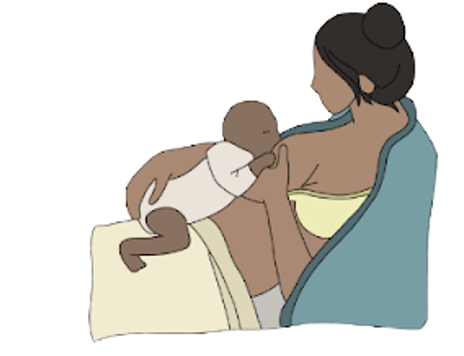
In this position, you are reclined and the baby is belly to belly with you. The baby's head is supported in the crook of your arm. This position is ideal in a bed or recliner. It can be particularly helpful for mothers that have a fast letdown or to help a baby get an optimal deep latch.

You and baby lying facing each other, belly to belly with baby's nose to nipple. This position can be particularly comfortable for nighttime feedings or anytime the parent needs to rest, relieve pressure from sitting or change positions throughout the day. Pillows can be used for support.
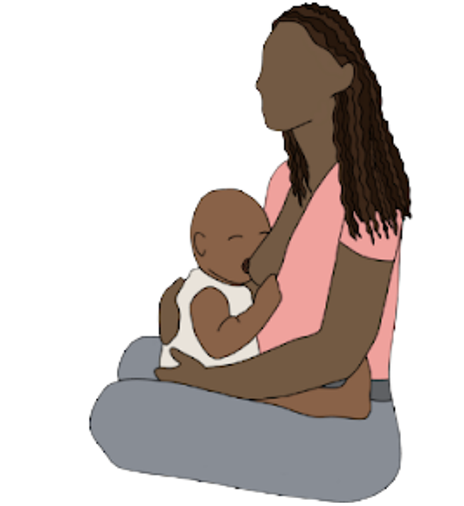
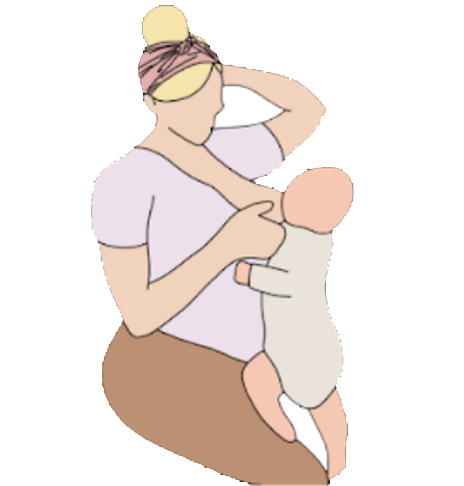
This position involves the baby straddling your thigh or hip, sitting upright while breastfeeding. It can be especially helpful as the baby grows older and can sit up with minimal assistance. This position is particularly useful for parents who use wheelchairs or for babies with reflux or ear infections, as it keeps them in an upright posture.
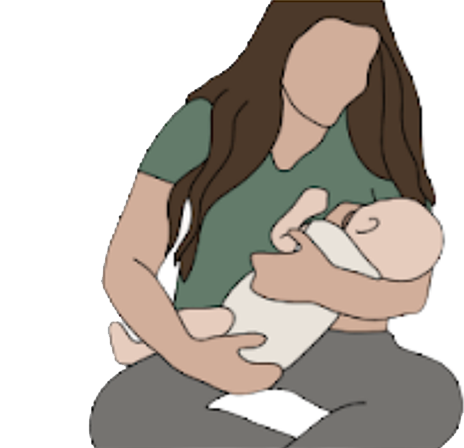
In this position, bring the baby across your belly and support their head with your arm. If you are feeding your baby in a seated position and the chair you are using does not have armrests, a nursing pillow can provide additional support.
Have resources to add? Email us at Disability-Pregnancy@Brandeis.edu for consideration.
 Sources
Andrews, E. E., Powell, R. M., & Ayers, K. B. (2021). Experiences of Breastfeeding among Disabled Women. Women's health issues : official publication of the Jacobs Institute of Women's Health, 31(1), 82–89. https://doi.org/10.1016/j.whi.2020.09.001
Frederick, A. (2015). Between stigma and mother-blame: blind mothers' experiences in USA hospital postnatal care. Sociology of health & illness, 37(8), 1127–1141. https://doi.org/10.1111/1467-9566.12286
Brown, H. (2023). Disability and in-hospital breastfeeding practices and supports in Ontario, Canada: a population-based study. The Lancet public health, 8(1), e47 - e56.
Powell, R. M., Mitra, M., Smeltzer, S. C., Long-Bellil, L. M., Smith, L. D., Rosenthal, E., & Iezzoni, L. I. (2018). Breastfeeding Among Women With Physical Disabilities in the United States. Journal of human lactation : official journal of International Lactation Consultant Association, 34(2), 253–261. https://doi.org/10.1177/0890334417739836
Ramer, S., Nguyen, A. T., Nelson, J. M., Whiteman, M. K., Warner, L., Thierry, J. M., Folger, S., von Essen, B. S., & Kortsmit, K. (2024). Breastfeeding by Disability Status in the United States: Pregnancy Risk Assessment Monitoring System, 2018-2020. American journal of public health, 114(1), 108–117. https://doi.org/10.2105/AJPH.2023.307438