
There are more than 63 million family caregivers (one in four U.S. adults) who support people with disabilities and chronic health conditions living in the United States today. Caregivers include parents, grandparents, spouses and partners, children, siblings, friends, and neighbors. The number of caregivers has increased substantially over the last decade, reflecting the growing importance of family caregivers in a national context where formal long-term services and supports systems are fragmented, challenging to access, and prone to funding shortfalls.
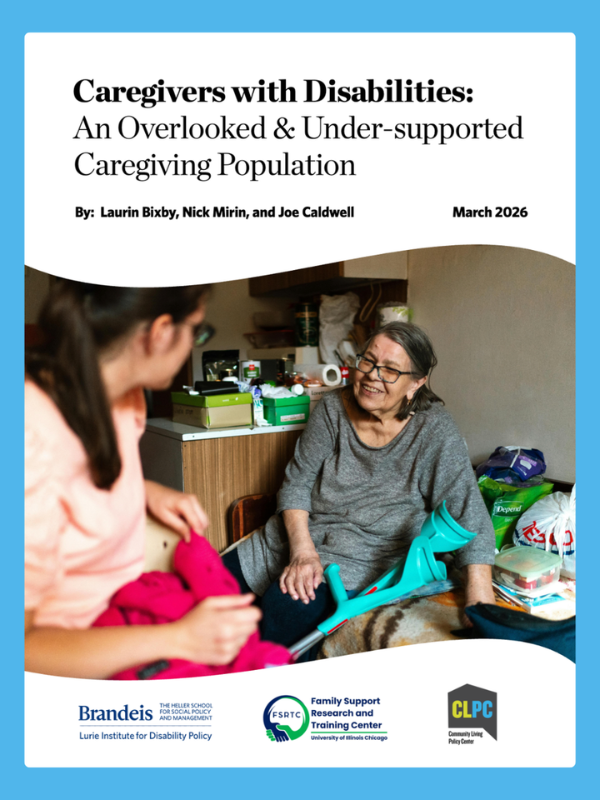 Though public awareness surrounding the importance of supporting family caregivers has increased in recent years, people with disabilities are usually framed solely as recipients of care and are rarely thought of as providers of care. Recent data from the Behavioral Risk Factor Surveillance System (BRFSS) challenges this assumption. In this brief, we present data from the 2021-2023 BRFSS.
An estimated 36% of adult family caregivers in the U.S. are disabled themselves. In fact, people with disabilities are more likely to be family caregivers than people without disabilities.
Despite disabled caregivers making up over a third of the caregiving population in the United States, we do not know much about their caregiving experiences or health and well-being, and current efforts to support family caregivers have not accounted for the needs of caregivers with disabilities. The purpose of this brief is to shed greater light on this largely unrecognized subpopulation of caregivers.
The BRFSS data provide essential context that can inform policy and advocacy efforts to support family caregivers with disabilities. We first describe who disabled caregivers are, highlighting how their demographics and caregiving experiences differ from nondisabled caregivers. We then examine social determinants of health, social and emotional well-being, and other health-related outcomes at the intersection of disability and caregiver status.
Findings show that disabled caregivers experience heightened levels of social, economic, and health disadvantage. We then call attention to policy recommendations based on the findings. Current and future programs to support family caregivers must be accessible, inclusive, and responsive to the needs of caregivers with disabilities.