
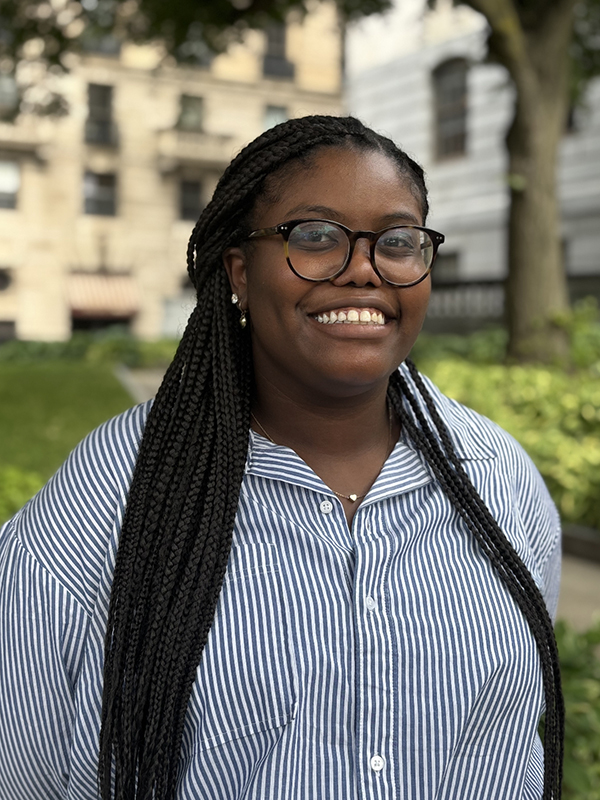
Quieraney Belvin is a second-year student in the Heller MPP program concentrating in economic and racial equity, an area she has been passionate about since growing up in poverty. As a child raised in Moody, Texas, Quieraney recalls being aware of economic disadvantages from a young age: “The town is separated by a rail line. My family’s side of the town is historically and legally classified as Coonlands; meanwhile, the public education is held on the other, ‘white’ side. It's not hard to see the poverty and segregation.”
She settled on specializing in economic and racial equity as an undergraduate at Texas State University to better understand the historical and sociological roots of these inequities between populations. After graduating with a degree in political science, Quieraney accepted a position as an Applied Behavior Analysis paraprofessional in Derry, New Hampshire, where she worked with K-12 students with autism. “Disability advocacy is a policy area I’m truly connected to as the sister and caregiver of a young woman with disabilities, and wife of a blind man. Working in special education tied two of my core interests together—I was able to teach and still advocate.”
Quieraney, knowing that she wanted to take the next step in her education, began looking into interdisciplinary programs that would both challenge and support her as a first-generation student. “I see myself in my future career working to spread knowledge, which I believe to be one of the greatest forms of activism. Telling stories and advancing knowledge is how we keep culture and power alive, so the Heller motto ‘Knowledge advancing social justice’ really connected with me.”
Quieraney accepted a fellowship with the Lurie Institute for Disability Policy to further explore her passion for disability advocacy: “It’s been a really great opportunity to work with an institution specializing in research that helps shape policy and practices to improve the lives of people with disabilities across identities,” she says. “The lived experience of people with disabilities is something that I think needs increased awareness and acceptance.”
Quieraney is currently working with Ilhom Akobirshoev, PhD’15, on a quantitative research project and analysis of a national public health data set, examining inequities and health outcomes and social determinants of health for patients with disabilities by disability type. “This type of analysis is new to me, so I’m excited to get this experience under my belt through my Lurie fellowship,” says Quieraney. “While I’m here at Heller, I want to continue to challenge myself.”
Looking beyond graduation in May 2026, Quieraney plans to continue her studies in a PhD program with the ultimate goal of teaching in higher education. “I’ve enjoyed my time at Heller so much, especially being a part of such a diverse community,” she says. “I grew up surrounded by one culture; coming to a place where so many walks of life—sexuality, ability, race, gender, ethnicity—are represented has been incredible. I think that’s what makes Heller such a fantastic community to be a part of. It’s this inclusive, thriving space of shared knowledge.”