
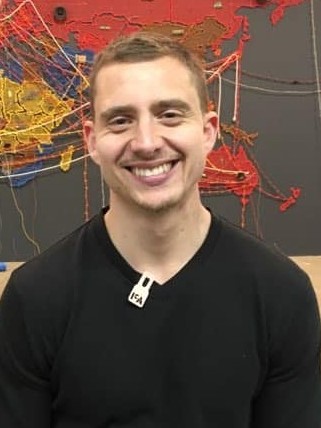
For Nick Schiavo, the path to a master’s degree was anything but traditional. After graduating from high school, he explored a range of roles—small business owner, personal trainer, general laborer and security professional. It wasn’t until the COVID-19 pandemic that he paused to reevaluate his long-term goals. “The pandemic forced a level of reflection I hadn’t done before. I realized that education was the key to creating a sustainable and meaningful career,” he recalls. That realization brought him to Massachusetts Bay Community College in 2021, where he began taking political science courses. He later transferred to UMass Boston, earning a BA in Political Science and a minor in Philosophy & Law.
During this time, Nick gravitated toward political theory. “As a first-generation college student from a lower socioeconomic background, I found political theory helped make sense of the structures I grew up around—especially in a diverse place like Somerville,” he explains. “It gave language to experiences my friends and I recognized but had never been able to articulate.”
Nick put his interest in writing and examining policy into practice during a summer internship with the City of Boston’s Office of Civic Organizing, where he gained insight into how policy functions at both the micro and macro levels. That work motivated him to take the next step in his education. He chose the Heller MPP program for its flexibility and its blend of empirical, theoretical and applied perspectives. After completing the MPP, he plans to pursue a PhD bridging real-world policy challenges with philosophical and historical analysis. “The MPP gives me hands-on policy experience. A PhD will give me the tools to teach and think critically about the systems we live in,” he says.
In 2025, Nick was awarded the Louis D. Brandeis Legacy Fund for Social Justice, which supported a summer research project with Professor Rajesh Sampath examining revolutionary theory, critical thought and urban sociology. Reflecting on the experience, he says, “What made the internship so impactful was the uninterrupted time to think. I spent the summer nose-deep in classical texts—reading, writing, sketching out research projects and learning how to sustain a long-form intellectual inquiry. It gave me the confidence that I could handle doctoral-level work and helped me see how theory can inform the concrete policy issues I care about.”
This academic year, Nick is also working as a course assistant in Introduction to Political Theory, an experience that has deepened his commitment to teaching and mentorship. “I’ve really reached out throughout the university to try to find spaces where I can be of use and to learn more,” he says. “I’m grateful to be in a position where I have opportunities to teach, learn and make a difference.”