
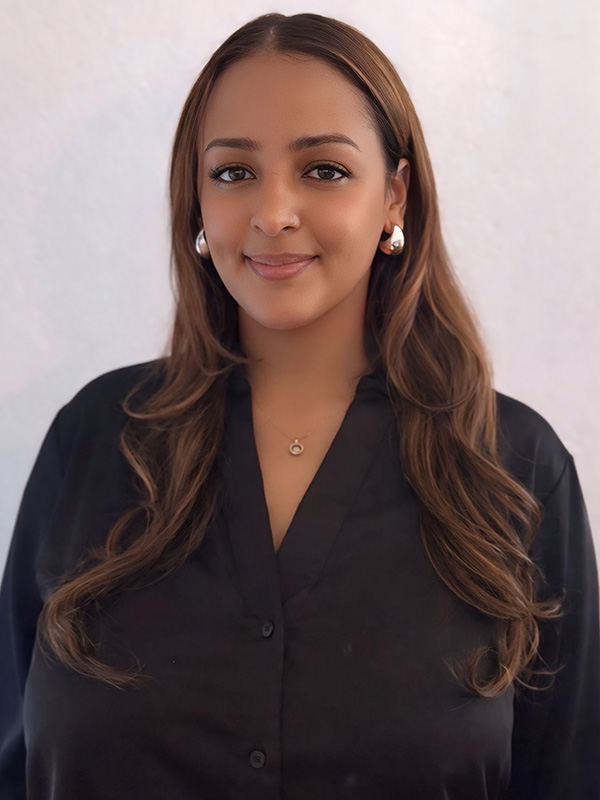
As an undergraduate at Brandeis, Ava Faria majored in Health: Science, Society & Policy (HSSP), and minored in African and African American Studies. A first-generation college student, she has always loved school and knew that her education wouldn’t be over after earning her bachelor’s degree. Ava had felt particularly drawn to international studies and global health, especially after delving into diasporic studies. After talking to her advisors and exploring her options at Brandeis, she saw that the Global Health 5-year Bachelor-Master of Science program at Heller would be the perfect segue into the next chapter of her academic journey.
Joining a diverse student body
Ava applied to the Global Health program in the spring of her junior year and began taking master's-level classes the following year. Eager to gain the analytical skills that are vital in an increasingly STEM-dominated field, she chose to focus on the health systems concentration. The program equipped her with these skills, as well as an understanding of how to use data to transform health systems.
Ava recalls thriving in the classroom as a Heller student: “It’s such a privilege to be in an environment shaped by so many diverse perspectives,” she says, recalling that her classmates came from a variety of countries with different health care systems. Many of them were medical doctors, who brought unique perspectives and experiences adapting to their populations’ changing health care needs: “The American health care system is very different from everywhere else in the world, so it was really impactful to question my own biases and assumptions of things, which were very westernized, and to learn how my peers were working on the ground every day across different contexts.”
Putting skills into practice
During her second year in the Global Health program, Ava worked with Food First—the Institute for Food and Development Policy, a nonprofit organization dedicated to creating free and open access resources to end the root causes of hunger. In her role as a Strategic Development and Governance Intern, Ava strengthened board and donor relations through prospect research, cultivation support and stakeholder communications. Additionally, she supported internal learning and equity-building processes by contributing to governance practices aligned with food sovereignty and participatory strategy frameworks.
Ava secured this internship through the career guidance and professional development resources offered by Heller. During her time at Food First, Ava was supervised by Camila Alejandra Bernal Fontal, MA SID’18, an experience that deepened her appreciation for the Heller alumni network and reinforced the program’s emphasis on values-driven, equity-centered leadership. The internship played a meaningful role in Ava’s Heller journey, allowing her to apply classroom learning to real-world governance and development work, particularly by translating concepts and frameworks from her coursework into the food sovereignty space.
Heller connections with a global impact
Since graduating from Heller, Ava has been working as an independent consultant for two NGOs. As a Development and Grant Prospecting Consultant at the Euphrates Institute, a nonprofit organization dedicated to cultivating a global community of peacebuilders, Ava is responsible for researching funding opportunities, leading outreach to prospective funders and partners and supporting grant submissions and fundraising. Her supervisor is a fellow Heller graduate, Krista Acosta-Edzie, MA SID/MBA'19, the Director of Programs and Development at the Euphrates Institute. At Y-Knot Missions, a Christian nonprofit organization based in Haiti focused on community-led development, Ava acts as a grants coordinator on a pro bono basis, providing strategic grants coordination support to grow organizational capacity.
Most recently, Ava accepted a full-time position as an Associate Consultant at Bash Advisory, a collaborative and results-driven consultancy that partners with nonprofits and philanthropies to drive meaningful change. In this role, she works on Bash Advisory’s social justice portfolio, supporting mission-driven organizations through fundraising strategy, research and donor-facing communications to enhance organizational capacity and sustainable funding.
“Heller equipped me with a curious mindset, which has been essential to my work in the development sector,” says Ava. “Every organization I’ve worked with operates in different settings and systems, often across different countries. Heller prepared me to ask meaningful questions, center lived experience and use data effectively to support meaningful work.”
Ava, who works virtually, is currently based in Ghana for two months, an opportunity she credits to the bonds she formed at Heller. “So many friends I made while in the program are from Ghana and connected me to people here,” she says. “It seemed like a great chance to immerse myself in the country and culture and experience firsthand how health systems, policy and social determinants of health interact in practice.” Since arriving in Ghana, Ava has met with professionals across a range of sectors, including medical doctors organizing community-based health services and policy consultants working on regional malaria initiatives with the African Leaders Malaria Alliance.
Advice for current students
Capitalize on your network: “The hard skills you learn are just as important as the connections you make. Venture out and meet people in other programs. Also take advantage of all of the opportunities and fellowships. Heller offers a wide range of resources for learning, whether that’s conferences, research opportunities, professional development, or simply talking with someone who’s willing to help you find funding and resources to pursue what you’re interested in. That level of support is unique and hard to find at other schools.”
Advice for prospective students
Explore all the opportunities that Heller has to offer: “One of the things that really sets Heller apart from other programs is the level of autonomy students have in shaping their education. Everyone is willing to work with you and make space for there to be creativity in how you’re learning and which courses you take. Also, take time to research your professors. You get to learn from leaders in their fields who have connections to institutions like the United Nations and the World Bank, and who bring a depth of knowledge and experience they’re eager to share.”