
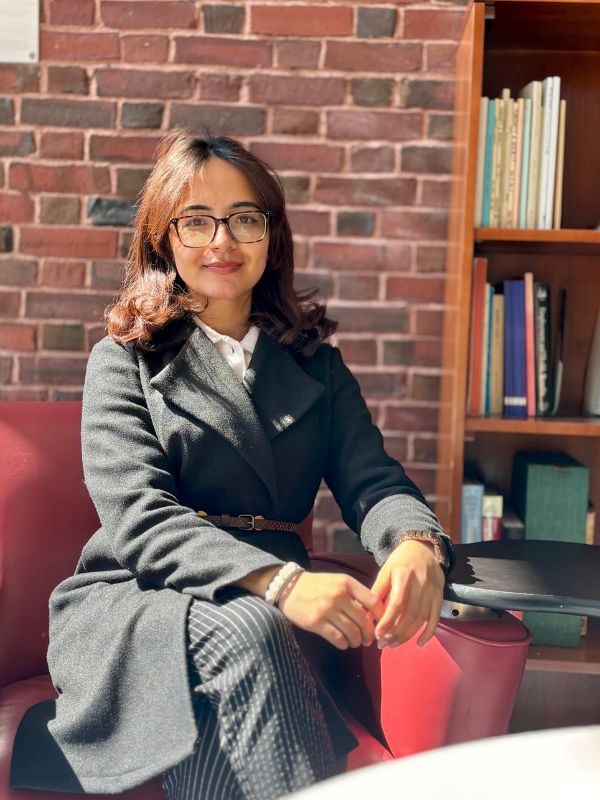
What motivated you to enter the global program at Heller?
I’m from Nepal, a Southeast Asian country, where I grew up in a family with a clinical background. However, I was always interested in public health and interventions to help populations on a larger scale. The Heller MS GHPM program was quite relevant to my undergraduate degree in public health and my work experience for the past four years in developmental organization and health research. Viewing the health systems in my country and throughout the world, I felt a growing need to diversify my knowledge, analytical viewpoints and greater understanding of health systems and policy dynamics on a global scale. The MS GHPM equips us with skills and knowledge on a global context, without limiting it to a mere country or community. These reasons led me to a conscious decision to choose MS GHPM as my graduate major.
How does the program prepare students to work across cultures, health systems, and policy environments?
Heller is a close-knit, diverse community where every student’s perspective is seen and heard. Students come from all over the world and bring different lived experiences, mindsets and skills through their work in global health, and they’re eager to share those experiences in classes with their peers and professors. After being at Heller, I have an enhanced perspective as a global citizen that I can share with other people and utilize in my own country’s system after graduation.
A highlight of being at Heller is getting to learn from esteemed professors who have had experiences in the field they are teaching us about. The classes and discussions are fascinatingly diverse—we have the opportunity to view and understand health problems through conventional and non-conventional lenses as socioeconomic, social justice, gender, etc. The coursework is designed to activate both the theoretical and analytical brain, covering policy, management and technical skills, like data analysis. I felt liberated to discuss my perspectives and was encouraged to create space for the same. Motivated by this, I, along with my MS GHPM peers, established a new working group in Heller, named the Brandeis Global Health Alliance. Whether it was discussing pressing global health concerns through podcasts or visiting renowned institutions, such as the World Bank, Heller always encouraged us beyond coursework.
Can you describe a class, project, or research experience that helps you understand health equity or global health disparities in a deeper way?
One class in particular that stands out is Professor Nandakumar’s course on international health systems and development. We were studying country-specific equity and PEPFAR, a U.S. government initiative to combat HIV/AIDS. This class taught me the importance of contextualization: every country has their own socioeconomic background, their own confounding factors and their own health system and economics. Different contextual factors and confounders in each country cannot be generalized across PEPFAR initiatives. For example, PEPFAR in the United States and PEPFAR in Nepal require a very different approach. This opened my eyes to how systemic change and policies can and should be implemented in order to make the greatest possible impact.
How has being a part of the Heller community shaped your experience within the program?
Ever since orientation, it’s been clear that Heller is a diverse, vibrant community—you can tell just by the many flags hanging in the Zinner Forum. The Heller community isn’t just limited to the classroom: we have professors, faculty, peers and advisors who are eager to provide support, whether it’s with research, projects, scientific papers or prospects beyond graduation. They are willing to facilitate networking opportunities according to our work interests, expertise and educational background. There are events, webinars and sessions that prepare us to think outside of the theoretical concepts of global health. I saw the motto “Knowledge Advancing Social Justice” placed on the Heller website, which I viewed before my admission, being tangibly executed during my time in the graduate program.
What is your advice for prospective students?
Come with an open mind and an open heart—bring your prior skills and experiences, and Heller will leverage them and help you grow accordingly. Be open to everything and do not hesitate to reach out to your peers, professors or faculty at Heller. Everyone is kind and supportive, hence your perspective will be heard and encouraged. Accompanied by a robust coursework on policy and economics, basic and advanced data health analytics, you’ll learn to step out, socialize and feel more informed and skilled for future endeavors.